• Homepage
  • About
    • Noblebright Fantasy
  • Blog
  • Stories of Fire and Stone
    • And The Wolves Danced
    • Calling On Fire
    • Fire Within
  • Burdens Of Magic
    • Claws Of The Curse

Stephanie Beavers

~ Always be yourself. Unless you can be a dragon. Then always be a dragon.

Category Archives: News

How Would You Like To Have A Penguin For A Best Friend?

10 Thursday Mar 2016

Posted by Stephanie Beavers in News

≈ Leave a comment

Tags

animal, animals, author, entertainment, fun, inspiration, life, penguin, pet, pets, Stephanie Beavers, wildlife, writer

‘Cause this guy has one. Check it out:

This penguin swims thousands of miles every year to visit the Brazilian man who saved his life. Joao Pereira de Souza found this Magellanic penguin crippled with oil-slicked feathers and close to death near his home. Joao cleaned him up and nursed him back to health. Now the penguin, dubbed JinJing, has adopted him.

“I love the penguin like it’s my own child and I believe the penguin loves me,” de Souza told Globo TV. “No one else is allowed to touch him. He pecks them if they do. He lays on my lap, lets me give him showers, allows me to feed him sardines and to pick him up.”

Picture credit: TV Globo

Picture credit: TV Globo

Although it’s not common, penguins do sometimes end up in Brazil after getting sent a little off course by currents. But I’m pretty sure this is the only one trying to replace dogs as man’s best friend.

Share this:

  • Click to share on X (Opens in new window) X
  • Click to share on Facebook (Opens in new window) Facebook
  • Click to share on Pinterest (Opens in new window) Pinterest
  • Click to share on Tumblr (Opens in new window) Tumblr
  • Click to share on Reddit (Opens in new window) Reddit
  • Click to email a link to a friend (Opens in new window) Email
Like Loading...

Dino Blocks Road

25 Thursday Feb 2016

Posted by Stephanie Beavers in Fun, News

≈ Leave a comment

Tags

author, dinosaurs, jokes, pranks, Stephanie Beavers, theft, triceratops, writer

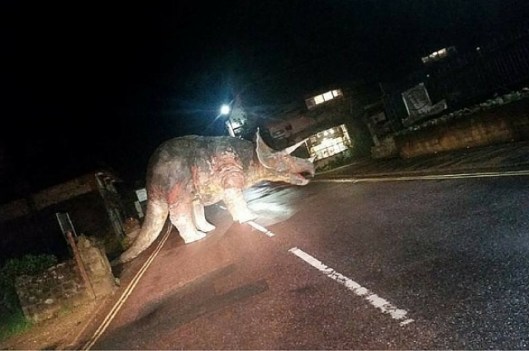
Huge Triceratops Blocks Road In The United Kingdom

Photo credit: Chris Hollingshead/Facebook

Photo credit: Chris Hollingshead/Facebook

Apparently, in the UK, when you’re drunk and bored, you steal giant dinosaur models and block roads with them. A fellow by the name of Chris Hollingshead posted the above picture to Facebook with the caption “That priceless moment when you’re driving home from work at 3am and the road is blocked by a 20ft Triceratops!!! ‪#‎godblessbeer‬ ‪#‎someoneneedsamedal‬”

A medal indeed. This triceratops is 7.6 meters or 25 feet long and heavy. The prank was pulled in the village of Godshill on the Isle of Wight in the U.K.

The dinosaur model comes from Island Gems, a fossil shop, where it is affectionately known as Godshilla.

Martin Simpson, the owner of Island Gems, told the BBC: “It takes about five blokes to move the dinosaur a couple of inches, so it was definitely a concerted effort and drink was probably involved.”

Mr. Simpson noted that Godshilla will now be tied down to prevent any future escapes.

So tell me, readers, how drunk would you have to be to steal a giant dinosaur and dump it in the middle of a street in the wee hours of the morning? Oh, and to convince enough of your buddies to help…

Share this:

  • Click to share on X (Opens in new window) X
  • Click to share on Facebook (Opens in new window) Facebook
  • Click to share on Pinterest (Opens in new window) Pinterest
  • Click to share on Tumblr (Opens in new window) Tumblr
  • Click to share on Reddit (Opens in new window) Reddit
  • Click to email a link to a friend (Opens in new window) Email
Like Loading...

These Here Are Drone-Killing Eagles

23 Tuesday Feb 2016

Posted by Stephanie Beavers in News

≈ Leave a comment

Tags

animal, animals, author, bird, birds, Drones, Dutch, eagle, eagles, future, nature, News, police, Stephanie Beavers, technology, wildlife, writer

Drones are an increasing problem, cluttering the skies, poking their noses where they shouldn’t be, and getting up to all kinds of mischief. Dutch police have gone back to nature in trying to solve this problem: eagles.

That’s right, these here are drone-killing eagles:

CNN reports: Dutch cops train eagles to hunt drones

Drones are now readily available to the public (and let’s face it, they’re pretty cool). My fiance even has one. I mean, it’s tiny and the battery only lasts about 10 minutes, but still. They’re proliferating. And when they’re getting too close to airports and flight-paths, measures need to be taken to protect the more important objects hurtling through the air – you know, the ones carrying people.

There is technology that “detects radio signals from rogue drones and uses tracking technology to force the drone to land,” which is pretty cool, even though it’s only in the research stage. But we all know as software improves, some drones will become impervious to that.

CNN lists some other countermeasures:

Countermeasures cited in the report included signal jamming, lasers, and the deployment of missiles, rockets and bullets, where it’s acknowledged there is high risk of collateral damage, and potential for “catastrophic damage” if they miss their target.

But eagles are pretty awesome. Let’s hear it for more eagles. Because what could possibly go wrong?

Share this:

  • Click to share on X (Opens in new window) X
  • Click to share on Facebook (Opens in new window) Facebook
  • Click to share on Pinterest (Opens in new window) Pinterest
  • Click to share on Tumblr (Opens in new window) Tumblr
  • Click to share on Reddit (Opens in new window) Reddit
  • Click to email a link to a friend (Opens in new window) Email
Like Loading...

Seagull Havoc

18 Thursday Feb 2016

Posted by Stephanie Beavers in News

≈ Leave a comment

Tags

animal, animals, author, bird, birds, french fries, fun, News, random, seagull, seagulls, Stephanie Beavers, troll, writer

I was perusing the internet when I saw this:

This has to be one of the best and most Australian things I have ever read… #Frankston #Seagulls @pedestriandaily pic.twitter.com/I3sjOIPPvV

— Grace Darken (@gracelace) February 1, 2016

.

Great story, but is it true? It would seem so: “Seagulls cause pandemonium on Victorian train”. There are a few other articles about it too, but who knows? At any rate, great story. (Buzzfeed added some colorful commentary to their article on the story.)

Share this:

  • Click to share on X (Opens in new window) X
  • Click to share on Facebook (Opens in new window) Facebook
  • Click to share on Pinterest (Opens in new window) Pinterest
  • Click to share on Tumblr (Opens in new window) Tumblr
  • Click to share on Reddit (Opens in new window) Reddit
  • Click to email a link to a friend (Opens in new window) Email
Like Loading...

The Best Mousetrap: 150 Years And Counting

08 Monday Feb 2016

Posted by Stephanie Beavers in News

≈ Leave a comment

Tags

animal, animals, author, history, life, mice, mouse, mousetrap, museum, nature, News, Stephanie Beavers, writer

How do you know it’s a good mousetrap? Well, because it’s 150 years old and still working great. Apparently we STILL haven’t built a better mousetrap. IFLS reported.

This is the mousetrap:

Image credit: Museum Of English Rural Life (MERL)

Image credit: Museum Of English Rural Life (MERL)


It actually wasn’t intended to catch the mouse. You see, it’s currently in a museum, the Museum of English Rural Life. Turns out that the mouse got in during construction for the redevelopment of the museum. They had other traps set, and yet THIS trap still managed to catch one.

Here is the mouse:

Image credit: Museum Of English Rural Life (MERL)

Image credit: Museum Of English Rural Life (MERL)


Poor little guy.

Here’s IFLS’s report:
Staff at the Museum of English Rural Life (MERL) opened their emails on Wednesday morning to find a rather odd message from a confused assistant curator, saying: “There appears to be a dead mouse in this mousetrap which is not described as being there on the database.”

Within the 150-year-old mousetrap, the curators did indeed find a fresh dead mouse. The museum has a wealth of textiles, straw and wood in its collection, but the unfortunate rodent happened to cross paths with the “old, not obsolete” mousetrap.

Adding further curiosity to the story, the trap was not baited with anything other than a layer of dust. The mousetrap is able to capture unwitting pests alive with a seesaw mechanism. As the mouse walks along an internal plank, the pest’s weight will tip the seesaw over, leaving it trapped in bottom of the box.

The contraption was patented and manufactured in 1861 by Colin Pullinger & Sons of Silsey, West Sussex. On the side of the box, it accurately boasts: “Perpetual Mouse Trap” and “will last a lifetime.”

But here’s what I think is the best part:

…the mouse remains in the trap while we decide what to do with it. One option is a dignified burial, another is to desiccate it or have it prepared to remain as a permanent feature of the mouse trap for our new displays. We’ll let you know what we decide.

You may have died, little mousey, but you get to become part of history! Yay!

So, readers, are you impressed by the mousetrap? Or just feeling sorry for this unlucky mouse?

Share this:

  • Click to share on X (Opens in new window) X
  • Click to share on Facebook (Opens in new window) Facebook
  • Click to share on Pinterest (Opens in new window) Pinterest
  • Click to share on Tumblr (Opens in new window) Tumblr
  • Click to share on Reddit (Opens in new window) Reddit
  • Click to email a link to a friend (Opens in new window) Email
Like Loading...

Not So Science Fiction After All, The Internet Could Out-Evolve Humanity

25 Monday Jan 2016

Posted by Stephanie Beavers in News

≈ Leave a comment

Tags

1984, ai, artificial intelligence, author, cyborgs, evil overlords, matrix, minority report, robots, Science, science news, Stephanie Beavers, technology, terminator, writer

Living things accumulate and reproduce information. That’s really the driving principle behind life, and behind evolution.

But humans have invented a new method of accumulating and reproducing information. It’s digital information, and it’s growing at an astonishing speed. The number of people using the internet is growing, as are the devices connected to it through the Internet of Things.

Photo credit: Beware the digital evolution. Pixabay, CC BY

Photo credit: Beware the digital evolution. Pixabay, CC BY

Digital information can copy itself perfectly, increases in copy number with every download or view, can be modified (mutated), or combined to generate novel information packets. And it can be expressed through artificial intelligence. These are characteristics similar to living things. So we should probably start thinking about digital technology as being like an organism that can evolve.

Digital information replicates with virtually no energy costs, and has rapid generation times. Artificial intelligence can beat us in chess and on game shows. What’s more, it’s faster than us, smarter than us in some arenas, and is already in charge of activities that are too complex for us to do efficiently.

To biologists, that sounds like the digital world might be able to out-compete us, as we argue in a paper published in Trends in Ecology & Evolution.

Information Growth

Any newly evolving entity can cause upheavals for life on Earth. In fact, all the major evolutionary transitions in the history of life have come about via changes to information storage and transmission.

And the digital revolution has certainly changed the way information is stored and transmitted.

The current storage capacity of the internet is approaching 1024 bytes and is growing at 30% to 40% per year, showing no signs of slowing down.

In the 3.7 billion years since life began, information in living things (DNA) has reached the equivalent of about 1037 bytes. Digital information will grow to this size in 100 years. That’s an evolutionary eye-blink.

Winners And Losers

During each evolutionary transition, there have been winners and losers. And we need to start asking if the digital transition poses a danger to humanity. We do have the advantage of hindsight to answer this question.

We know that each of earth’s evolutionary transitions essentially resulted in the enslavement of the old information carriers. RNA was the original carrier of information. When DNA came along, the role of RNA was relegated to simply relaying messages from DNA to the cell.

When complex cells arose, they subsumed simpler bacterial cells. These became power generators (mitochondria) or solar panels (chloroplasts), serving the needs of the new cell types.

The next transition resulted in organisms with multiple cells. Most of these cells did not pass their information to the next generation, but existed simply to support those few cells that did.

The development of nervous systems that collected information from the environment provided huge advantages for animals. This activity reached its peak in human societies, with transmission of information between generations, via language and culture.

This allowed humans to dominate the planet, such that we have triggered a new geological epoch, the Anthropocene.

Extinctions

So the lessons of evolutionary history are clear. Transitions in the way information is replicated and stored often make existing organisms extinct, can lead to parasitism, or in the best case scenario, lead to a co-operative, mutual relationship.

Global leaders are already warning about the danger of autonomous military robots taking over the world, reminiscent of horror science fiction such as The Terminator.

We are increasingly connected to the digital world via devices, and direct connections to our brains are on the horizon. If we fuse our brains with the internet we may gain new sensory and cognitive capabilities.

But we may also lose our grasp of what is “us” and what is “real” (The Matrix, Inception), or expose ourselves to digital parasites.

As our activities and physiological states are increasingly being monitored, tracked and analysed, our every thought and action could be predicted (George Orwell’s 1984 or the Minority Report). Biological information systems might then become a predictable cog in a digitally governed social system.

Decision systems and artificial intelligence networks mimic human brains, and coordinate our everyday interactions. They decide on what internet advertisements we are exposed to, execute the majority of stock exchange transactions and run electric power grids. They also have a significant role in human mate choice via internet dating sites.

While we do not necessarily feel that we are the mere flesh-bots of our digital overlords, the merging of humans with the digital world has now passed the point of no return.

In biological terms, fusions like these between two unrelated organisms are called symbioses. In nature, all symbioses have the potential to turn into a parasitic relationship, where one organism fares much better than the other.

We need to start thinking about the internet as an organism that can evolve. Whether it cooperates or competes with us is cause for considerable concern.

Michael Gillings, Professor of Molecular Evolution; Darrell Kemp, Senior Lecturer in Biological Sciences, and Martin Hilbert, Professor in Communication, University of California, Davis

This article was originally published on The Conversation. Read the original article.

Share this:

  • Click to share on X (Opens in new window) X
  • Click to share on Facebook (Opens in new window) Facebook
  • Click to share on Pinterest (Opens in new window) Pinterest
  • Click to share on Tumblr (Opens in new window) Tumblr
  • Click to share on Reddit (Opens in new window) Reddit
  • Click to email a link to a friend (Opens in new window) Email
Like Loading...

These Birds Are Scarier Than You

18 Monday Jan 2016

Posted by Stephanie Beavers in News

≈ Leave a comment

Tags

animal, animals, author, badass, birds, clever, creepy, falcons, hawks, nature, scarier than you, Science, science news, smarter than you, Stephanie Beavers, wildlife, writer

Fiendish Falcons Keep Birds Prisoner Before Eating Them
Australian Raptors May Be Playing With Fire

So it turns out that birds are terrifying. Majestic, oh yeah, but beneath that majesty are some twisted little birdies.
proud brown falcon

There are some falcons in Morocco that, around egg-hatching season, take some pretty extreme measures to keep their food “fresh.” Why eat rotten bird when you can “[stuff] small birds into small crevices, ensuring they were tightly wedged in and unable to escape,” or dropping “small migratory birds [into] holes and fissures with their flight and tail feathers removed” so they couldn’t fly away. Now, I know nature can be cruel, and I don’t doubt that having fresh food for the hatchlings is an evolutionary advantage, but…yikes. This is downright creepy.

Haven’t had enough cruel animal brilliance? How about this one. There are many stories and evidence to suggest that birds of prey in Australia are starting fires to flush out prey. They’re not just taking advantage of existing wildfires that drive small creatures from their homes. Oh no, They are “picking up smoldering sticks and dropping them in unburnt territory.” It’s another creepy, evolutionarily advantageous behavior.

“Reptiles, frogs and insects rush out from the fire, and there are birds that wait in front, right at the foot of the fire, waiting to catch them,” Gosford said. Small fires often attract so many birds that there is insufficient fleeing prey for all, so a bird that was being beaten to its lunch might benefit from starting a new fire with less competition.

So yeah, you could say that these birds are scarier than you. When was the last time you started a fire to flush out lunch?

Share this:

  • Click to share on X (Opens in new window) X
  • Click to share on Facebook (Opens in new window) Facebook
  • Click to share on Pinterest (Opens in new window) Pinterest
  • Click to share on Tumblr (Opens in new window) Tumblr
  • Click to share on Reddit (Opens in new window) Reddit
  • Click to email a link to a friend (Opens in new window) Email
Like Loading...

Tortoises Only: THIS SECRET TIP WILL BLOW YOU AWAY

11 Monday Jan 2016

Posted by Stephanie Beavers in News

≈ Leave a comment

Tags

183 years old, advertising, animal, animals, author, diet, News, old tortoise, phishing, spamming, Stephanie Beavers, tortoise, wildlife, writer

I was browsing animal news on National Geographic when I came across this: Healthy Diet Helps 183-Year-Old Tortoise Feel Young Again …And I immediately did a mental facepalm.

Am I the only one who immediately thought of all those cheesy alarmist/click-me-now-before-you-think ads that permeate the internet? Like this headline: “Enjoy Flat Abs With These 10 Super Foods” or this one: “30 Mind Blowing Photos You Won’t Believe Are Real.” We’ve all seen the ads. They’re impossible to avoid, even with the best ad-blocker.

I mean, I’m happy that Mr. 183-Year Old Tortoise is feeling better, but don’t you feel like, if you read the article, someone’s going to try to sell you a dieting program or phish your information? I’m not sure what my point is, but I thought it was hilarious and wanted to share.

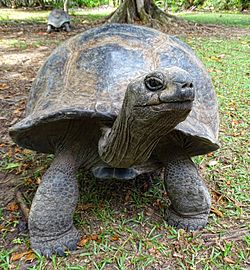
Jonathan the tortoise is 183 years old

An Aldabra Tortoise

In any case, that’s one very old tortoise, and it’s entirely possible I’ll die before he will. Live long and prosper, Jonathan The Tortoise.

Share this:

  • Click to share on X (Opens in new window) X
  • Click to share on Facebook (Opens in new window) Facebook
  • Click to share on Pinterest (Opens in new window) Pinterest
  • Click to share on Tumblr (Opens in new window) Tumblr
  • Click to share on Reddit (Opens in new window) Reddit
  • Click to email a link to a friend (Opens in new window) Email
Like Loading...

Mutant Mountain Lion

07 Thursday Jan 2016

Posted by Stephanie Beavers in News

≈ 2 Comments

Tags

animal, animals, author, cat, cats, cougar, mutant, mutation, Science, science fiction, science news, Stephanie Beavers, wildlife, writer

So this is a little disturbing:

Photo credit: Idaho Fish and Game mutant cougar

An anonymous hunter shot the above cougar in Idaho. And it evidently has… horns? teeth? growing out of its head.

The hunter didn’t know it, but he stumbled across the machinations of an evil scientist creating an army of mutant animals! Maybe. …Okay, probably not.

Still, it’s a little disconcerting. IFLS has more details, but in short, no one knows what exactly is up with this twisted kitty.

Here are the theories:
“Firstly, it could be that it has a teratoma. This is a rare type of tumor that spawns a grotesque growth capable of containing hair, bone, teeth, and even parts of limbs or organs. These tumors are incredibly rare in humans, although there have been a few isolated examples in the animal kingdom among dogs, horses, and other mammals.

Second, it could be the remnants of a “conjoined twin” that possibly died in the womb and was absorbed by the mountain lion.

Lastly, it could be the result of an injury to the cougar’s teeth or jaw, which healed in an unfortunate way. Zach Lockyer, a local wildlife biologist, told Idaho State Journal that this is perhaps the least likely of the possibilities as the image doesn’t appear to show any injury or trauma around the jaw.”

So readers, what do you think caused it? Teratoma, conjoined twin, trauma, or evil scientist?

Share this:

  • Click to share on X (Opens in new window) X
  • Click to share on Facebook (Opens in new window) Facebook
  • Click to share on Pinterest (Opens in new window) Pinterest
  • Click to share on Tumblr (Opens in new window) Tumblr
  • Click to share on Reddit (Opens in new window) Reddit
  • Click to email a link to a friend (Opens in new window) Email
Like Loading...

Snakes Are Slimy After All

28 Monday Dec 2015

Posted by Stephanie Beavers in News

≈ Leave a comment

Tags

animal, animals, author, nature, reptile, reptiles, robots, Science, science news, slimy, snake, snakes, Stephanie Beavers, wildlife, writer

So, snakes are pretty cool. But before I really knew anything about them, I heard people call them “slimy.” However, when I first met (and was able to touch) a snake, I found that their scales actually felt dry to the touch. I summarily dismissed sliminess as an insult by those who dislike snakes and moved on. Apparently I was a little too hasty.

Here’s the Secret to How Snakes Slither

Well, I was and I wasn’t.

Scientists have found a surprising explanation for snakes’ effortless slithering: A mind-bogglingly thin coat of fatty lubricant embedded on the snakes’ scales.

Thin really does mean thin. And snakes use this lubricant to keep from getting stuck on things as they drag their bodies along. This discovery points “the way toward new kinds of industrial lubricants and coatings, not to mention improved designs for snake-inspired robots.”

Snake robots. Heck yeah.

green snake is secretly slimy

So why didn’t we know snakes really were slimy?

Unlike creatures such as snails, which smooth their path by secreting and leaving behind trails of wet lubricant, the snakes’ lubricant stays embedded on the scales themselves, forming a durable, slick layer similar to what keeps our joints lubricated and limber.
And since the snakes’ lubricant doesn’t wipe off, people handling snakes were none the wiser.

Once again, scientists are seeking to imitate nature’s advanced “technology” to get ahead.

Nature has figured it out over millions of years,” says Weidner. “We can try to understand its little secrets.

Check out the article linked at the top for more details. It’s pretty cool.

Share this:

  • Click to share on X (Opens in new window) X
  • Click to share on Facebook (Opens in new window) Facebook
  • Click to share on Pinterest (Opens in new window) Pinterest
  • Click to share on Tumblr (Opens in new window) Tumblr
  • Click to share on Reddit (Opens in new window) Reddit
  • Click to email a link to a friend (Opens in new window) Email
Like Loading...
← Older posts
Newer posts →

Mailing List

Sign up for book release notifications HERE!

Enter your email address to follow this blog and receive notifications of new posts by email.

Calling - Ebook Calling On Fire by Stephanie Beavers!
Two brothers with magical abilities seek to stop an evil mage only to find the fate of an entire race in their hands.
Buy now!

Recent Posts

  • Happy Easter 2017!
  • The pufferfish is more romantic than you.
  • Enjoying Music Again: Home Free
  • Noblebright Fantasy
  • Skittle Addiction

Categories

  • Fun
  • Life
  • News
  • Recommendations
  • Thoughts
  • Writing

Meta

  • Create account
  • Log in
  • Entries feed
  • Comments feed
  • WordPress.com
Philosophy, kittens, and candy.
Disclaimer: The "be a dragon" quote is not mine. If you know who originally said it, please let me know so I can give due credit!

Blog at WordPress.com.

  • Subscribe Subscribed
    • Stephanie Beavers
    • Join 232 other subscribers
    • Already have a WordPress.com account? Log in now.
    • Stephanie Beavers
    • Subscribe Subscribed
    • Sign up
    • Log in
    • Report this content
    • View site in Reader
    • Manage subscriptions
    • Collapse this bar
 

Loading Comments...
 

    %d